Michaelmas, 29th September 1693. As night falls, Samuel Pepys, former Secretary to the Admiralty and Member of Parliament – better known today as one of history’s great diarists – rides by coach with his friend John Jackson and a group of ladies, bound for Chelsea. As the events would later be relayed in court,
in the dusk of the Evening three Persons (having their Faces covered with Vizard Masks) met his Coach, (being all on Horse-back) and holding a Pistol to the Coachman's Breast, and another against Mr. Pepys, commanded the Coach to stand, demanded what they had.
Pepys gave over everything: among other things, a silver ruler, five mathematical instruments, a magnifying glass, a gold and silver purse, and 20 shillings cash. It was an expensive loss.
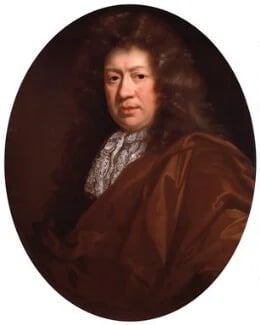
An older Pepys, attributed to John Riley. Oil on canvas, c. 1690. Image: National Portrait Gallery.
This story is worth recalling not only as a reminder of a lesser-known episode in a life which is, by seventeenth-century standards, uniquely well documented, but to draw attention to an overshadowed detail. The most valuable item Pepys lost that fateful night was not the gold purse or precision-made instruments, but a gold pencil valued at £8.
That he was carrying a pencil may seem unremarkable (though a whopping £8 – roughly £1000 in today’s money – is something we’ll return to). Yet the pencil’s presence as an incidental detail is a reminder that these writing implements are too often deprived of centre stage in histories of knowledge and communication.
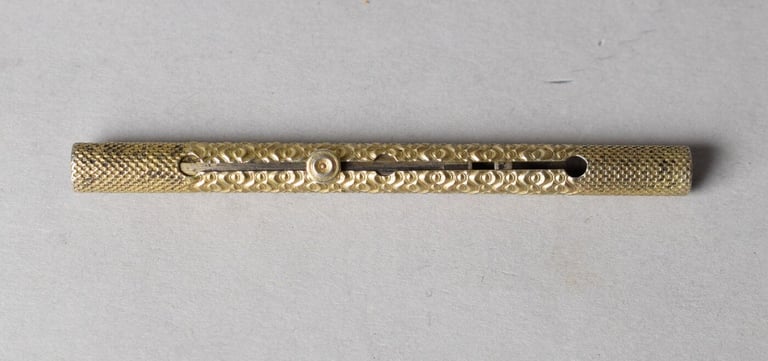
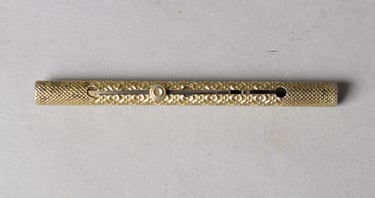
Silver-gilt pencil holder, c. 1720 (V&A Museum LOAN:GILBERT.1087-2008). A luxury item, perhaps like that owned by Pepys.
Why, then, do we live in such a pennacentric world? It’s the ink-dispensing pen that has become synonymous with the act of writing: ‘The pencil is mightier than the sword’, anyone? I don’t think so.
And with only a few exceptions, like art historians studying drawing, pencil is the poor relation to its attention-grabbing sibling when it comes to historical research. Most of the documents historians use – from medieval chronicles to nineteenth-century business records, legal documents to love letters – come to us in the ink-black curls of the pen.
But let this not distract us from an important reality: the pencil, though perhaps a less glamorous writing implement, has a long history worthy of greater attention.
Origins
As this British Library article explains, pencils can be traced back at least a thousand years to the Aztec use of graphite markers. In Europe, lead or silverpoint was used for some forms of writing and drawing dating back to the Middle Ages, and graphite writing emerged as it was gradually discovered in various places, including Bavaria in the fifteenth century, and Borrowdale in England’s Lake District in 1564.
The story goes that some shepherds ran to shelter under a tree during a thunderstorm, and when the tree was struck by lightning and uprooted, the exposed ground below revealed an intriguing metallic substance that proved particularly useful for writing.
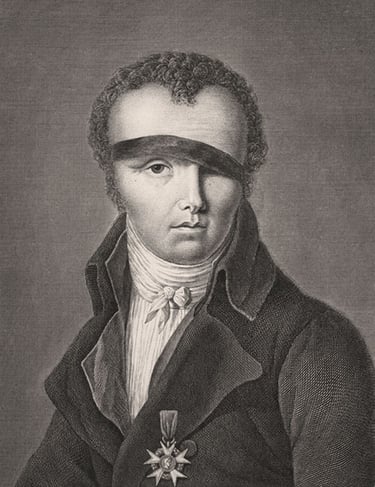
Nicolas-Jacques Conté (1755–1805), father of the modern pencil.
The pencil as we know it today was patented in 1795 by a French mathematician and soldier in Napolean’s army, Nicolas-Jacques Conté, who worked out a method of mixing powdered graphite with clay to form a narrow cylinder enclosed within a wooden casing.
Pencils in everyday life
Even before pencils took their modern form, however, the use of graphite writing objects was widespread. We know of Pepys’ highway robbery because the case was tried before London’s famous criminal court, the Old Bailey. And sure enough, Old Bailey records from the late seventeenth century onwards are littered with cases of stolen pencils, especially pricier ones made of precious metals or ivory. Today we’re all well acquainted with notions of the ‘humble pencil’, but in the past such objects ranged from cheap, utilitarian implements to fine luxury goods, like that owned by Samuel Pepys.
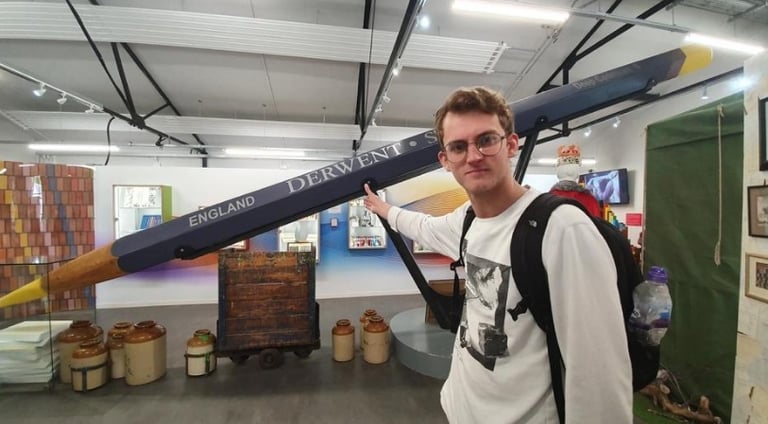
These and other fascinating tales are told at the Derwent Pencil Museum in Keswick, Cumbria, not far from where graphite was discovered in 1564.
Contemporary instructional texts and how-to books offer a sense of the everyday uses of pencils, such as artistic and technical drawing. Pencils could take a variety of forms, whether feathered implements more akin to brushes, or the ‘lead’ pencils closer to what we have today. Popular manual Art’s treasury (1688) recommended a drawing technique involving outlines made first with charcoal, before tracing over it with black lead pencil and finally adding the finishing touches in pen. Pencils could also be used to mark wood or ivory before engraving designs.
These were also handy tools for craftspeople, surveyors, and others involved in technical drawing. The author of one 1668 textbook on drawing boasted of using a ‘Black-lead Pencil… and holding it as I do a Pen, and resting the end of my little finger upon my paper, turning the paper about with my left hand, and have described a Circle so exact, that a pair of Compasses could not discover an errour’.
The printer and tradesman Joseph Moxon’s Mechanick exercises (1677–84)identified many uses for pencils, such as marking lines on wood to cut or file along. The fact that Pepys was robbed of his pencil alongside a ruler and mathematical instruments suggests his use must have been similarly technical.
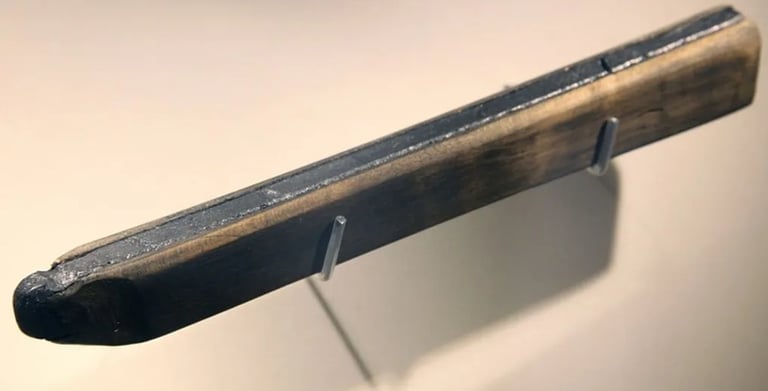
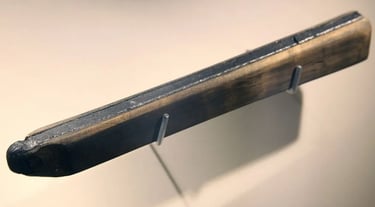
This is said to be the oldest known pencil still in existence, found in a house dating from 1630. Image: BBC
Whispers in writing
For all the practical uses of pencils for drawing and writing, the fact that their marks were easily erased meant that their status and survival lacked the certainty of pen. This impermanence had obvious drawbacks, illustrated by one Old Bailey case of 1740, in which a thief stole a copy of Abel Boyer’s renowned English-French dictionary from the bookseller Henry Warr, before pawning it. When, some days later, Warr found the suspected copy at a pawnbroker’s shop, he noticed the thief had tried to erase his pencil bookseller’s marks, and could only identify the volume as the attempted erasure had left telltale marks.
Yet in other cases erasability was a strength. 1678’s The compleat comptinghouse, for example, taught youngsters matters of business and bookkeeping, and recommended marking up accounts in pencil as they were reviewed.This distinguished the financial records from the auditor’s jottings, which could be removed to leave a fair copy.
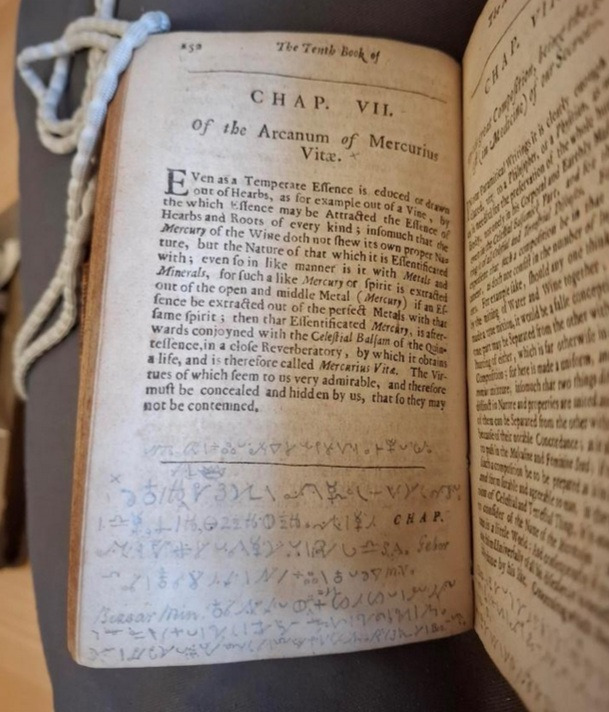
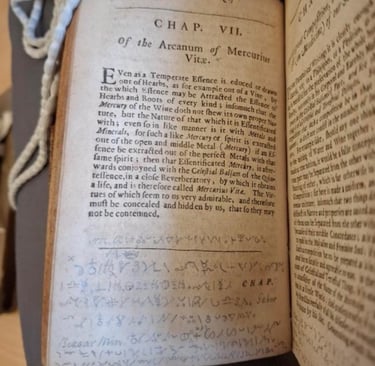
Pencilled-in alchemical symbols for planets and metals in a 1663 copy of Paracelsus his Archidoxis (Glasgow University Library, Sp Coll Ferguson Ap-b.33).
Pencils and historians
Given the likelihood of erasure, it’d be tempting to assume that pencil was everywhere in centuries past and has simply been lost. This is probably a stretch; we read in Nancy Um’s study of coffee in eighteenth-century Yemen, for example, that in 1735 the Dutch East India Company was ordering 300 quills for its merchants in Mocha, compared to just 12 pencils. So while we can’t assume that pencil was more common than pen, it’s striking to consider just how much pencil writing must now be lost
However often pencil was used as a communicative tool, the value judgements implied by its use bear thinking about. One reading of historic pencil writing is of information that was deemed somehow less worthy of preservation. The use of pencil (and indeed of pen) must be viewed as a conscious choice, and given that one of the central tasks of the history of knowledge is to think about how certain forms of know-how have been hierarchised, closer examination of the decisions historic writers made about their medium must be worthwhile.
But more than that, pencil writing gives us a glimpse of knowledge and ideas that were less tangible, but perhaps no less important. To write in pencil was to record things knowing they may later be erased, to acknowledge the likelihood of mistakes, to convey doubt and uncertainty, fleeting thoughts, work in progress. Pencil writing was the outline before the carving, the marked-up manuscript: an exercise of the mind not yet made up.
These are matters we should take seriously when thinking about knowledge in the past as well as the present. In contrast to the brazen self-confidence of LLMs which spew information, whether accurate or not, as though it’s fact, the pencil allows us to accommodate uncertainty. As Carol Beggy recently observed, pencil has survived ‘despite (or perhaps because of) its impermanence’. Today, it’s estimated that two billion pencils are made across the globe annually. Perhaps, then, it remains an ideal medium for our uncertain times.
Sources
The Proceedings of the Old Bailey, 1674-1913, https://www.oldbaileyonline.org/
Anon., The Excellency of the pen and pencil (London, 1668).
Carol Beggy, Pencil (New York, 2024).
Joseph Moxon, Mechanick exercises (London, 1677–84).
John Vernon, The compleat comptinghouse (London, 1678).
John White, Arts treasury (London, 1688).
Nancy Um, Shipped but Not Sold: Material Culture and the Social Protocols of Trade during Yemen's Age of Coffee (Honolulu, 2017).