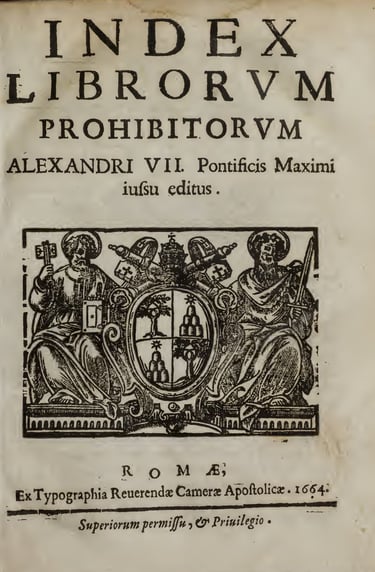
Rules of the Index
Published by the authority of the Sacrosanct Synod of Trent
Rule I
All books which popes or oecumenical councils have banned before 1515 and are not included in this index are to be considered banned just the same, just as they had once been banned.
Rule II
Books by the arch-heretics, those who after the aforementioned year [1515] came upon or encouraged heresies, as well as those who are or were figureheads or leaders of the heretics – such as Luther, Zwingli, Calvin, Balthasar Hubmaier, Schwenckfeld, and others like them, [their books] of whatever names, titles, or arguments put forward, are entirely prohibited.
…
Also books of committed Catholics, both by those who later lapsed into heresy as well as by those who after lapsing returned to the bosom of the Church, and have been approved by a faculty of theology of any Catholic university or by a general inquisition may be permitted.
Rule VII
Books which expressly discuss, tell, or teach lascivious or obscene matters, because they are used to easily corrupt by their lessons not only faith but also morals, it would make sense for them to be banned altogether. And those who keep them would be severely punished by the bishop.
But the pagan Ancients, due to the quality and elegance of their writing, shall be permitted. But by no means should they be read out to children.
Rule VIII
Books whose main argument is good, but in which inserted in passing is what seem like heresy or irreligiousness, divination, or superstition, having been purified by Catholic theologians on the authority of the general inquisition, could be allowed.
The same rule shall apply to prologues, summaries, or annotations by damned authors, put forward in books that have not been banned, but in the future they will be printed only if they have been amended.
Rule IX
All books and writings on geomancy, hydromancy, aeromancy, pyromancy, onomancy, necromancy,* or writings which contain divination, potion-making, augury, divination by omens, and magical incantations, must be entirely rejected.
*These are all different methods of divination using, respectively: the earth, water, air, fire, names, and the souls of the dead.
Indeed, the bishops must diligently make sure that no books, treatises, or indices be read or kept, which deals with astrology, concern possible future things, things that are to follow, future fortunes, or actions which depend on human will, and dare to assert with certainty anything that is to happen.
However, opinions and natural observations which concern navigation, agriculture, or the medical art, that have been deemed helpful, should be permitted.
Regulæ Indicis
Sacrosanctæ Synodi Tridentinae iussu editæ.
Rugula I
Libri omnes, quos ante annum MDXV aut summi Pontifices, aut Concilia œcumenica damnarunt, & in hoc Indice non sunt, eodem modo damnati esse censeantur, sicut olim damnati fuerunt.
Regula II
Hæresiarcharum libri, tam eorum, qui post predictum annum, hæreses invenerunt, vel suscitarunt, quam qui hæreticorum capita, aut Duces sunt, vel fuerunt, quales sunt, Lutherus, Zvvinglius, Calvinus, Balthasar Pacimontanus, Shvvencfeldius, & his similes, cuiuscunque nominis, tituli, aut argumenti existent, omnino prohibentur.
…
Libri etiam catholice conscripti, tam ab illis, qui postea in hæresim lapsi sunt, quam ab illis qui post lapsum ad Ecclesiæ gremium redice, approbati a facultate Theologica alicuius Universitatis Catholicæ, vel ab Inquisitione generali, permitti poterunt.
Regula VII
Libri qui res lascivas, seu obscænas, ex professo tractant, narrant, aut docent, cum non solum fidei, sed & morum, qui huiusmodi librorum lectione facile corrumpti solent, ratio hebenda sit, omnino prohibentur: & qui eos habuerint, severe ab Episcopis puniantur.
Antiqui vero, ab ethnicis conscripti, propter sermonis elegantiam, & proprietatem permittuntur: nulla tamen ratione pueris prælegendi erunt.
Regula VIII
Libri, quorum principale argumentum bonum est, in quibus tamen obiter aliqua inserta sunt, quæ ad hæresim, seu impietatem, divinationem, seu superstitionem spectant, a catholocis Theologis Inquisitionis generalis auctoritate expurgati, concedi possunt.
Idem iudicium sit de prologis, summarijs, seu annotationibus, quæ a damnatis auctoribus, libris non damnatis appositæ sunt: Sed posthac non nisi emendati excudantur.
Regula IX
Libri, omnes, & scripta Geomantiæ, Hydromantiæ, Aeromantiæ, Pyromantiæ, Onomantiæ, Necromantiæ, sive in quibus continentur sortilegia, veneficia, auguria, auspicia, incantationes artis magicæ, prorsus reijciuntur.
Episcopi vero diligenter provideant, ne Astrologiæ iudiciariæ libri, tractatus, indices legantur, vel habeantur, qui de futuris contingentibus, successibus, fortuitisve casibus, aut ijs actionibus quæ ab humana voluntate pendent, certo aliquid eventurum affirmare audeant.
Permittuntur autem iudicia & naturales observations, quæ navigationis, agriculturæ, sive medicæ artis iuvandæ gratia, conscripta sunt.