Concerning the Hedgehog’s and the Bear’s fights
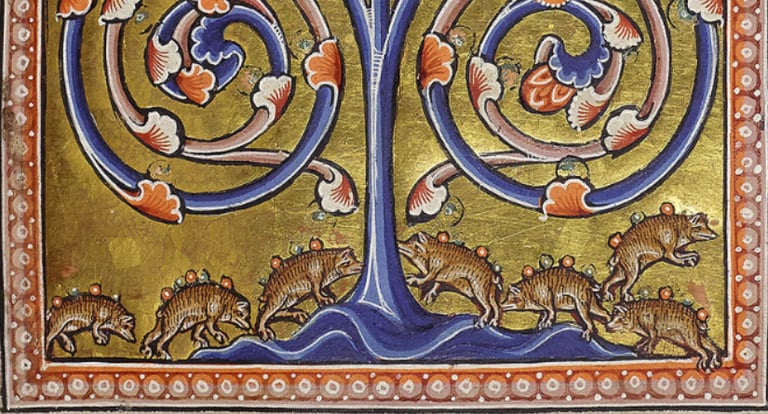
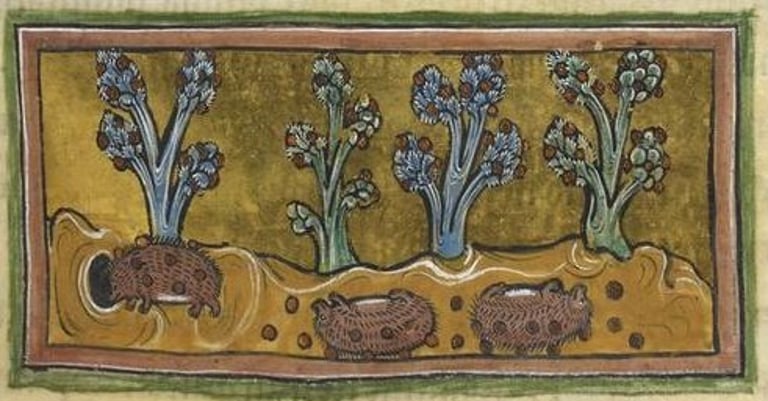
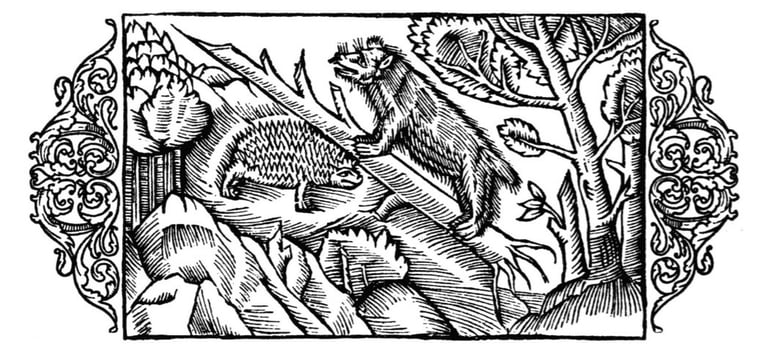
The hedgehog is covered with sharp spikes, with which he gathers fruit to nourish himself, and he stores them in hollow trees. He trusts these spikes so much that he even dares to bother bears in their dwellings. In doing this, he risks succumbing to the bear’s enormous weight, for the latter resorts to tricks such as the one depicted in the illustration above [in the accompanying illustration, the bear can be seen trying to crush the hedgehog using a tree], or something of the like. The bear uses this trick when the hedgehog rolls itself into a ball, so nothing but the spikes can be reached.
Yet neither by this defence, nor by casting its own urine, can the hedgehog prevail against the bear when it seeks revenge for the violation of its home. On the other hand, the bear cannot devour this prey of his, miserable and pitiful though it may be, since it is far too sharp and prickly to be a snack. Therefore, he returns to his den and rests there […]
If he [the hedgehog] were captured in this condition and his flesh roasted it would, unlike all other meat, turn black, not the slightest sign of moisture would be found in its belly, nor in the region of the heart except for a few drops, and no blood elsewhere in the body.
In the spring, the male [bears] emerge extremely fat even though they have nourished themselves on nothing but sleep for fourteen days, for reasons which have not yet been determined. Aristotle asserts that land bears hide themselves during the winter, but whether they do this because of the cold or because of other reasons is an open question. It may, however, be explained with the following reasons: first and foremost, they can’t have their footprints tracked in the snow; further, his natural instinct drives him to it so that he does not get torn apart by wolves which are more fierce in the winter than at other times; and also it may avoid injuring its soft paws on the sharp ice. It is unlikely that the bear hides itself because of the cold, for its fur is so thick that snow frost and ice cannot penetrate it. Indeed, during the harshest winter, bearskins are commonly used to preserve warmth when one must travel by sled day and night.
The bears also fight battles with wild boars, but they rarely emerge victorious, as the boars use their large teeth for a better defence than deer or bulls have in their horns or swiftness. Pregnant mares are protected by strong stallions with their teeth and kicks against the bears. The foals save themselves by racing away: nevertheless, the fear remains in them, making them unfit for war. It is a common strategy in warfare to send forth a warrior dressed in bearskin against the enemy, in order to scare the horses which were once exposed to bears.
It should be noted that smaller animals, when pushed to distress, often kill those larger and stronger than themselves. This has been shown in the case of the weasel and the elk, and above in the case of the sharp hedgehog and the hairy bear, as the latter is forced to yield. Indeed, even the bravest champions may in combat with a desperate foe have to endure dangers which they had never foreseen or perhaps dismissed.
The full Swedish version is available through litteraturbanken, pp. 840-841.
https://litteraturbanken.se/författare/GranlundJ/titlar/HistoriaOmDeNordiskaFolken/sida/-1/faksimil