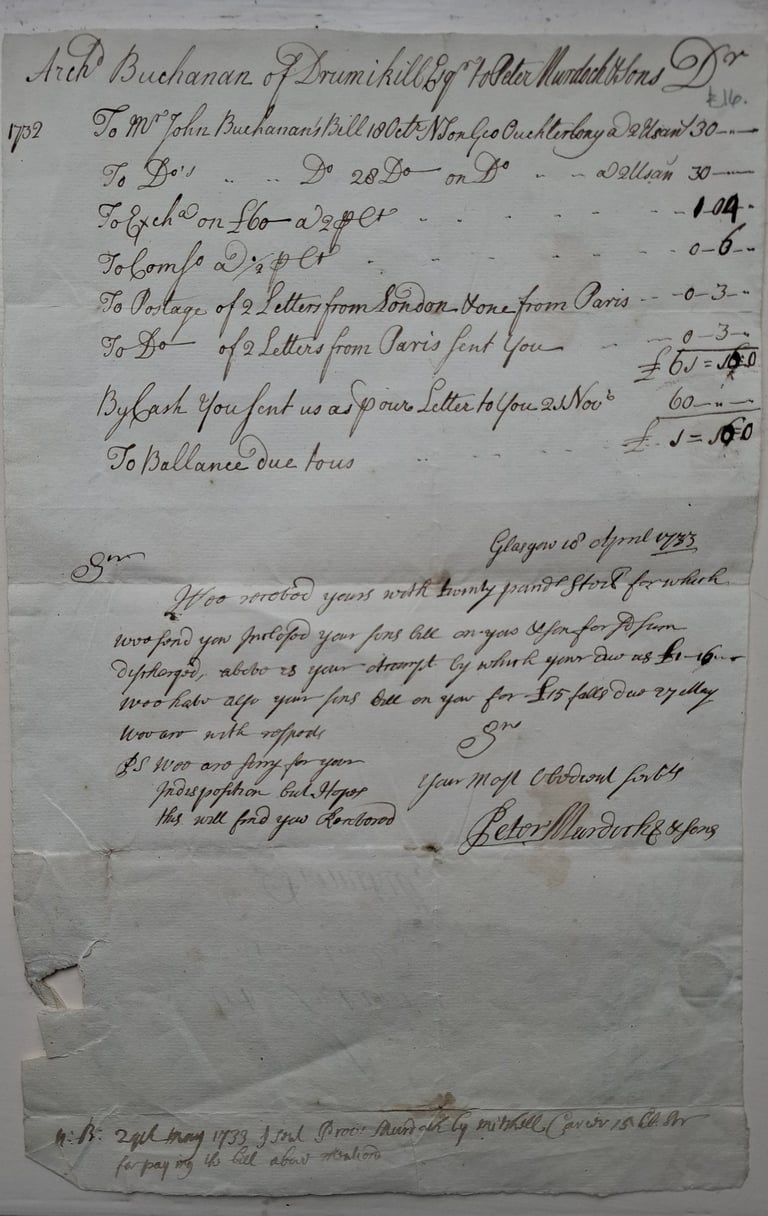
Earlier this year at the Edinburgh Book Fair, I bought a seemingly innocuous document. Lying in a bookseller’s box of ‘ephemera’, it was unmistakably an eighteenth-century financial account of the sort anyone familiar with Scottish records of the period is likely to encounter. At first glance there was little to write home about: a small number of transactions and the names of the debtor and creditor. But for just £16 it seemed like a worthwhile investment in a piece of history.
Later on, however, a quick google suggested that the document may have been of deeper interest. The parties named in the account were both men of some significance: Archibald Buchanan of Drumikill (1701–1761) a minor nobleman, and Peter Murdoch (1670–1761), a prominent Glasgow sugar merchant, and Lord Provost (chief magistrate) of the city from 1730–1732. Perhaps, then, there was more to this item than meets the eye.
Britain’s colonial past
As a sugar merchant in the early-to-mid-eighteenth century, Murdoch was closely tied to the trade in colonial goods. An outpouring of research in recent years has done much to uncover Scotland’s deep connections to transatlantic colonialism and slavery, particularly since the eighteenth century. All too often, the evidence appears to be hiding in plain sight. Take a brief walk through central Glasgow today and you’ll inevitably cross streets bearing the names of people now recognised to have profited enormously from trading goods such as sugar and tobacco, grown on plantations relying on chattel slavery. Early histories like T. M. Devine’s 1975 study of Glasgow’s ‘tobacco lords’ did much to uncover the mechanics of colonial trade, but the inhumanity and violence it involved was often conspicuous by its absence in such accounts.
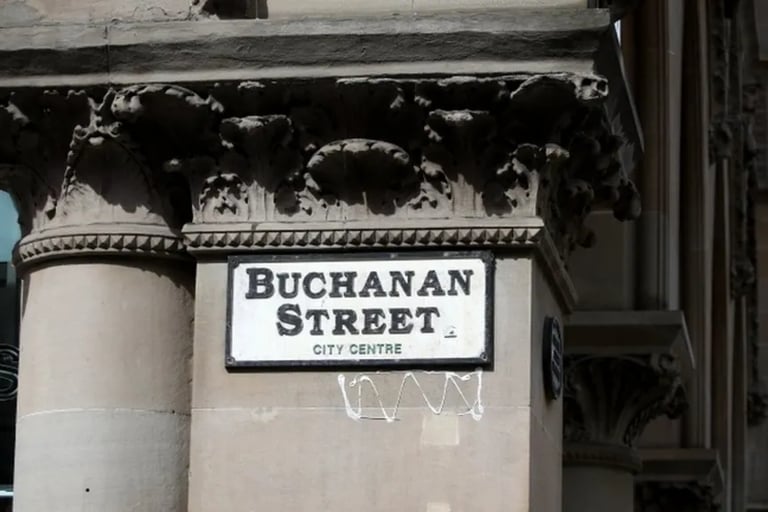
Buchanan St in Glasgow is named after tobacco trader Andrew Buchanan. Image: BBC
Yet even if at times the evidence appears to be staring us in the face, the short financial account between Buchanan and Murdoch, with its mundane list of financial records, offers a reminder of how, in some cases, the sources we have can obscure as much as they reveal.
The account
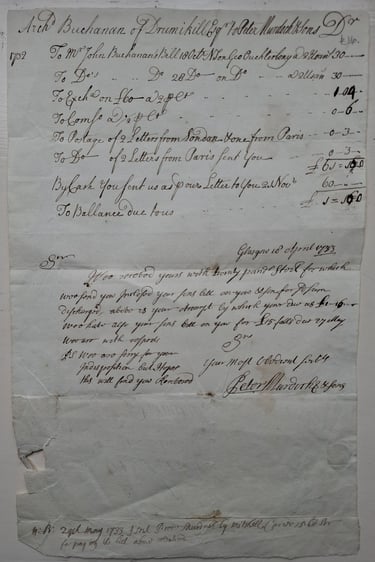
Little in this document provides evidence of the nature of Murdoch’s business. Dating from 1732–33, around the end of his provostship, it lists various debts to Murdoch incurred by Buchanan. Sums owed include two outstanding bills of £30 for unspecified debts, plus smaller sums for exchange fees, postage from London and Paris, and a cash payment of £60 in return from Buchanan to be deducted, leaving an outstanding balance of £1 and 16 shillings to be paid: hardly revealing details.
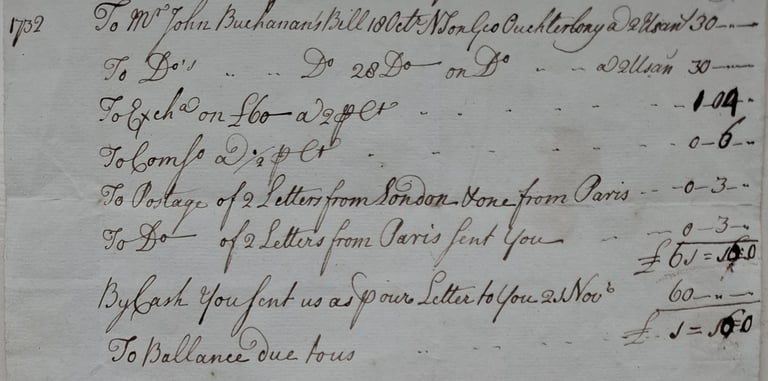
Transactions reckoned to a balance in Murdoch’s account with Buchanan, 1732.
Without much detail to go on, and determined to dig deeper into the man behind the numbers, I headed to Scotland’s national archive, the National Records of Scotland, and began working through every item I could find bearing Murdoch’s name. Learning about his social networks was straightforward enough. The connection between Murdoch and Buchanan clearly ran deep, evidenced by a 1728 marriage contract between Murdoch’s daughter and Buchanan in an arrangement that saw the latter make significant investments in land as security. There was also some correspondence between Buchanan and Murdoch discussing financial matters, and a few other bills and bonds.
Typically of a merchant active in civic affairs, Murdoch also appeared periodically in the records of the Court of Session, Scotland’s supreme civil court. We learn from these that Murdoch was banking with a partnership in London, which may explain the letters posted there on Buchanan’s behalf, as listed in the account.
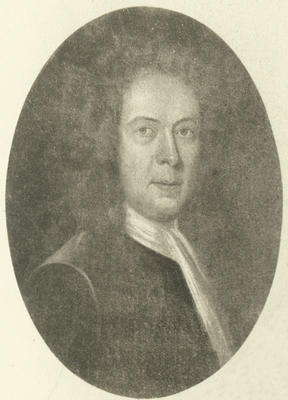
Peter Murdoch. Image: The Glasgow Story
What is most striking about all this documentation, however, is how silent it is on the exact nature of Murdoch’s business. Despite so much detail on financial affairs, there was precious little mention of the sugar trade. In fact, a short letter of 1716 to the Duke of Montrose regarding the sugar refinery in which Murdoch was a partner was the only explicit mention I found of his trade in colonial goods
Of course, this was only a brief search, and more thorough investigation would undoubtedly yield greater details about Murdoch’s affairs. Nor is it by any means certain that the transactions in this account pertained to colonial trade. But the absence of details about Murdoch’s business in what are otherwise extensive records of financial actions serves as a reminder of the ways historical documents can present us with certain narratives over others.
Accounting for lost experience
One thing of which this document is certainly indicative is the growing importance of written financial accounting over the eighteenth century, just as Britain’s overseas empire was expanding rapidly. These two processes were not merely coincidental. Accounting facilitated long distance commerce, and this included trade in goods produced by slave labour, and in enslaved peoples themselves. As Jennifer L. Morgan has recently shown, accounting played an important role in colonial violence by commodifying human lives.
Sometimes though, it’s the silences in these documents that are most revealing. Financial accounts, perhaps more so than most historical sources, are often treated as mines of information on economic matters, rather than as texts with their own partialities. Yet behind the ostensible objectivity of terse entries and sums of money lie objects and people, thoughts and actions, which remain absent from the record. These documents are, by their nature, abstractions of reality. Quantification acts as a way of condensing the material world to numbers on a page, and it’s here that human experience is lost.
Whether or not this account had anything to do with the sugar trade, its silences – and the silence of many other documents pertaining to Murdoch – are a reminder of the paradoxical way in which recordkeeping can obscure important aspects of history. It was surely by no means the case that whoever wrote the account, whether Murdoch himself or an employee, intended to obfuscate reality by hiding details of slave labour. Rather, the conventions of accounting dictated that only terse financial entries needed to be recorded.
Today, the extent to which Britain’s modern-day wealth is a result of colonial trade and chattel slavery is a matter of (often politicised) debate. As governments continue to weigh up issues such as reparations, historians have a vital role to play in informing decision making. Documents such as that considered here may not tell us much on their own, but they demonstrate how oblique some of the evidence can be in uncovering connections between daily economic affairs within Britain, and colonial trade.
Sources
National Records of Scotland
CS228/M/2/78, Murdoch v Johnston and Bell, 1729.
GD1/512/1 Antenuptial marriage contract between Archibald Buchanan, merchant in Glasgow, and Martha Murdoch, daughter of Peter Murdoch, merchant, late bailie there, 1728.
GD47/536 Correspondence: Provost Peter Murdoch… to Archibald Buchanan of Drummikill, 1738–41.
GD220/5/682, Correspondence of James, 1st Duke of Montrose, 1716.