
Recent headlines generated by policy makers, educators and advocates for financial literacy are all pointing to an alarming conclusion: much of the world today faces a ‘numeracy crisis’. As it turns out, many of the inequalities and prejudices surrounding numeracy have centuries-old roots.
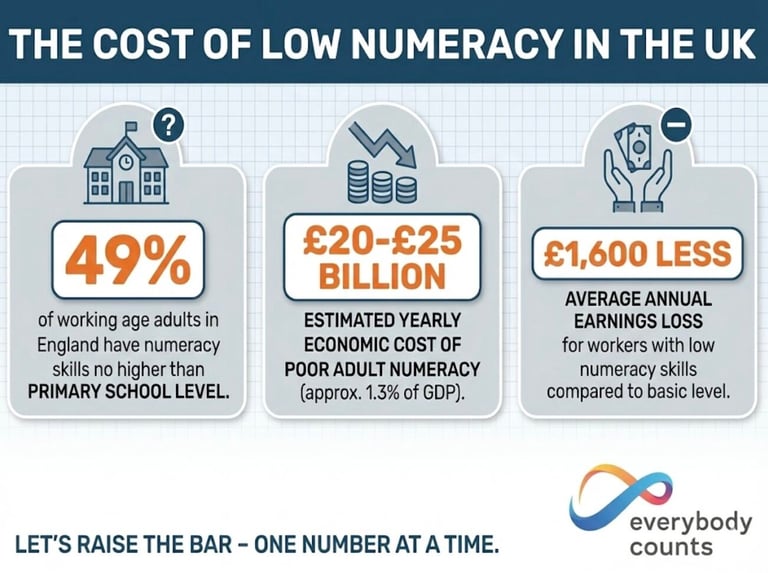
In the UK, the issue of poor numeracy is brought most sharply into focus once a year on National Numeracy Day. Organised by the charity National Numeracy, the occasion is part of a broader initiative to improve everyday maths skills among the public in response to damning findings about low numeracy among both children and adults, which can cause reduced employment opportunities and earnings, as well difficulties handling financial matters.
One key takeaway from recent studies into numeracy is that not only knowledge, but attitudes and confidence towards numbers, vary considerably among different social groups. A 2022 report by the charity distinguished between ‘skills’ and ‘confidence’ in levels of attainment, and found that whereas ability in numerical matters varied only slightly, deeper divisions in gender and wealth lay in those groups’ confidence in using numbers.
Numeracy in historical context
Understanding today’s numeracy crisis, then, demands that we investigate the cultural history of attitudes towards numeracy. The way writers in the seventeenth and eighteenth centuries discussed numerical matters gives us a sense of where modern-day attitudes originate. This was a crucial era for the development of numeracy and mathematics as we know them today. Growing appetite for foreign travel and colonial expansion saw advances in cartography, navigation and astronomy. A ‘horological revolution’, spurred by the production of more accurate clocks, precipitated more precise timekeeping. Inexpensive textbooks such as Cocker’s Arithmetick sold in hundreds of thousands of copies. And ever louder calls to standardise weights and measures culminated in the Imperial System introduced in 1824.
In turn, writers keen to promote these new and exciting forms of knowledge eagerly disparaged people whose number skills appeared different or less advanced. In a recent deep-dive into the world of early modern travel literature, for example, I found countless examples of explorers and naturalists who observed numerical practices in localities across the world and concluded that European methods were superior.
Extolling the virtues of this new mathematics led to disparaging accounts of foreign practices, reinforcing European notions of refinement and civility. As early as 1636 the merchant Lewes Roberts remarked that one who lacked ability in ‘the Art of Numbring or Arithmetique… may not challenge to himselfe the Title of a Merchant … nor hardly deserve the attribute of a rationall man’.
French missionary Charles de Rochefort’s account of the Caribbean, translated into English in 1666, was particularly scornful in its appraisal of the numeracy of Caribbean islanders compared to both Chinese and European accountants. Rochefort took for evidence of the islanders’ ‘sottishness and simplicity’ that ‘they cannot count a number exceeding that of the Fingers of their Hands and the Toes of their Feet, which they shew to express the said number, what exceeds it surpassing with them all Arithmetick’.
Though not all travel accounts were so prejudiced, in these texts the inability to count and calculate in ways familiar to Europeans became a lens through which the ‘otherness’ of non-europeans was constructed .
Powerful ideas
What’s most remarkable about these descriptions is just how enduring they proved. In the eighteenth century, during what is often known as the ‘Age of Enlightenment’, some of the most influential thinkers of the day drew on travel accounts in constructing theories of learning, cognition and history, cementing the idea that certain forms of numeracy were hallmarks of ‘civilisation’.
John Locke, the most influential educational writer of his day, displayed an especially deep and sustained interest in foreign forms of numeracy in his private correspondence, and in turn his Some thoughts concerning education (1693), advocated teaching arithmetic to gentry boys at a time when elite education still prioritised a humanist curriculum in Latin and Greek.
One of the bestselling historians of the day, Scottish Historiographer Royal William Robertson, drew on many travel accounts’ depictions of numeracy in his History of America (1777), leading him to conclude that ‘Among civilized nations, arithmetic, or the art of numbering, is deemed an essential and elementary science… But among savages, who have no property to estimate, no hoarded treasures to count, no variety of objects or multiplicity of ideas to enumerate, arithmetic is a superfluous and useless art’.
A lasting legacy
Quite ironically, the numeracy disparaged in travel accounts, such as counting with objects and an inability to perform written calculation, remained common even in Britain. The ways contemporary writers discussed numerical matters was less a reflection of everyday reality as much as their desire to promote new forms of knowledge. Yet their ideas had a potent impact on educational culture.
Over the seventeenth and eighteenth centuries, number skills increasingly became synonymous with formal education in schools and depended on the abilities to read and write. Because literacy was heavily socially stratified, and schooling was often beyond the reach of working families, this new emphasis on ‘textbook’ written arithmetic over utilitarian numbers skills useful in daily life generated new social barriers to numeracy. Inability in written mathematics became a marker of intellectual inferiority in a way it hadn’t been before.
It seems, then, that the social barriers to numeracy persistent today have deep connections to developments of the past four centuries. In matters of numeracy, having the skills to navigate daily life successfully has always been the most important thing, but the ways numeracy is taught, measured and understood have marginalised some social groups, and led to a crisis of confidence in everyday number skills.
If, as recent reports suggest, a key element of the numeracy crisis is about the way we perceive mathematics, changing the narrative will mean reversing centuries of thinking about what kinds of numeracy we value.
Recent social studies suggest grave concequences for low numercy in the UK. Image: Everybody Counts
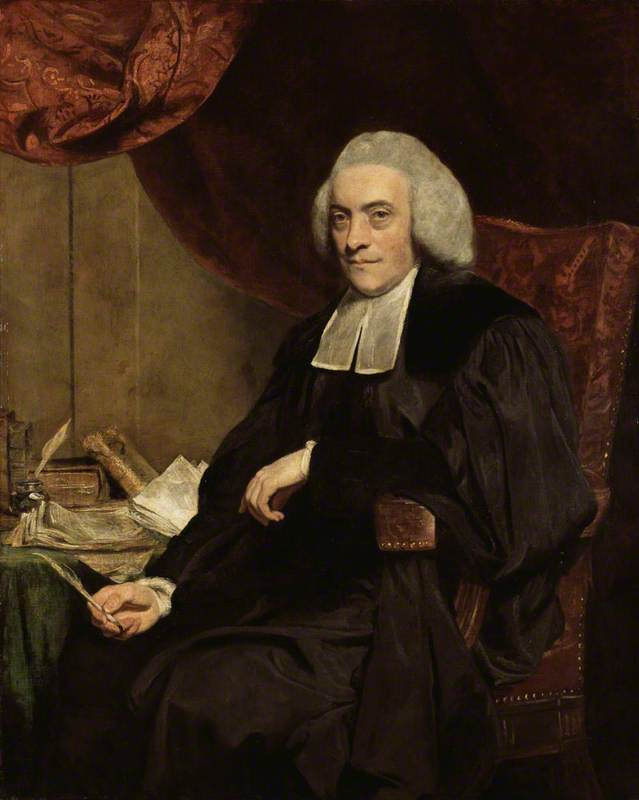
William Robertson's History of America received criticism for its negative portrayal of Native American culture.
The case is especially pronounced across gender divisions. Across all age groups, employment statuses and levels of affluence, women sit below men in number confidence. Among university students especially, there is very little difference in ability between men and women, but huge disparities in confidence levels. Another study suggests that numeracy attainment in young children is connected to levels of ‘maths anxiety’ among parents.
This might help to explain why school-age girls continue to lag behind boys in science and maths, while from universities to the workplace, STEM subjects remain male dominated.
Many of the issues surrounding numeracy attainment seem to stem from the way mathematics is taught and assessed in schools. In 2025 a House of Lords Committee found that the current education system is failing children, 30% of whom fail to achieve a Grade 4 (a standard pass) in GCSE maths (taken at age 15 or 16). There are obvious disadvantages to making passing a mathematics exam the chief criterion by which ‘success’ in numerical matters is defined, and so one of the Committee’s main objectives is addressing attitudes towards numeracy.
All these findings point to the fact that equipping people with the numeracy skills essential for modern life means changing cultural assumptions which marginalise certain social groups.
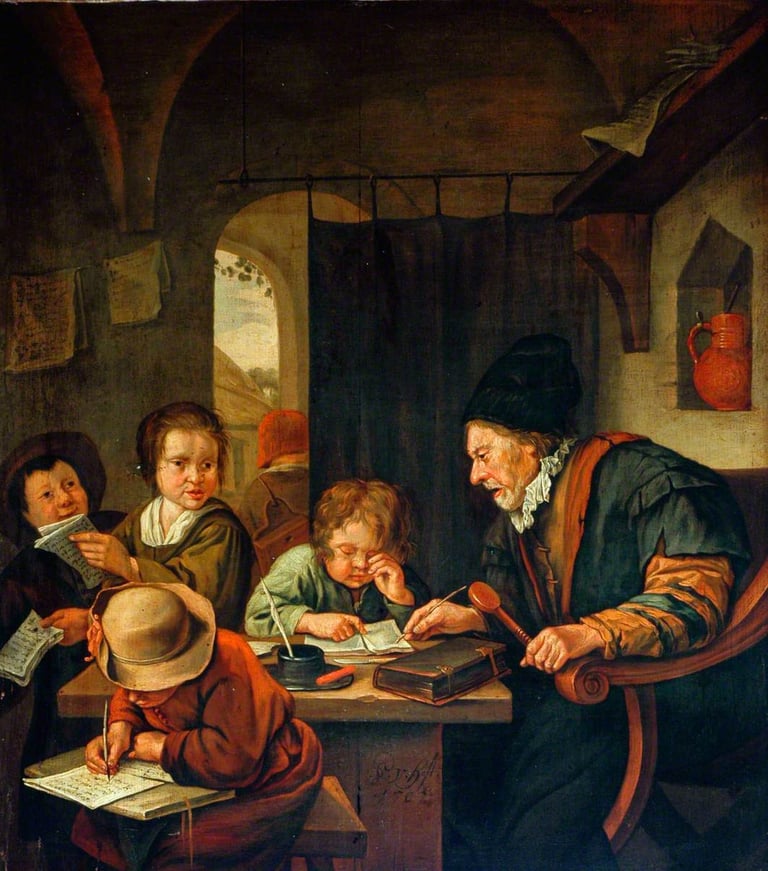

Pieter van Host, The Village School (1707)